Google Maps Rank Tracker
Google Maps Rank Tracker: See Where Your Business Shows Up for the Searches That Matter
Searching for yourself on your own phone does not tell you what customers see. RankBunny checks your Google Maps and local search positions for your chosen keywords from fixed locations on a regular schedule, so you can see real trends and tell whether your work is paying off.
Get a free visibility checkRead the FAQWhat is a Google Maps rank tracker?
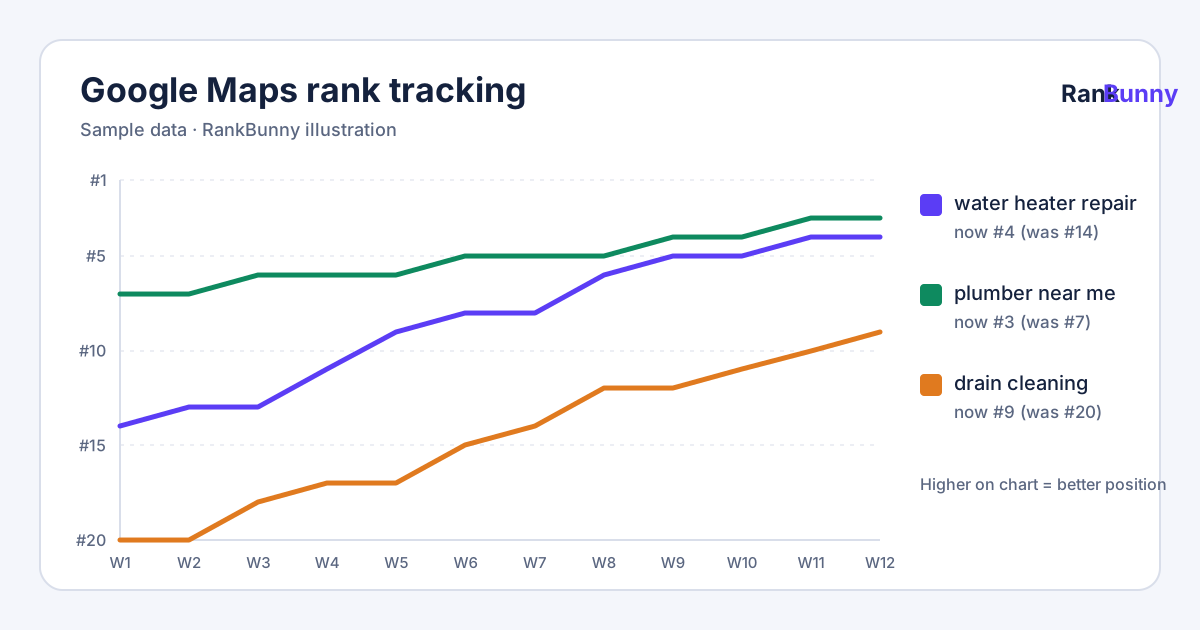
A Google Maps rank tracker records the position your business appears in Google's local results for a chosen keyword, searched from a chosen location, and repeats that check on a schedule. Because local results change with the searcher's location, a good tracker checks from consistent points and shows the trend over time rather than a single result.
Why your own Google search is not a reliable ranking check
Many owners check their ranking by searching on their own phone. The result is usually misleading, for three reasons:
- Location. Google says distance from the searcher is one of the main factors in local results. Searching from inside your shop puts you at a big advantage that customers across town do not see.
- Personal history. Google can tailor results using your past activity, and you have probably visited your own profile and website many times.
- Timing. Local results move. A single check on a single day can catch an unusual result.
A rank tracker removes these problems by checking from set locations, without your personal history, on a regular schedule.
What RankBunny rank tracking measures
Map results position
Where your profile appears in the Google Maps results list for each keyword.
Local pack presence
Whether you appear in the small group of map results shown on a normal Google search page.
Keyword trends
How each position changes week to week and month to month, with completed work marked on the timeline.
Location view
Positions from several points in your service area, shown in detail on the local search grid.
Competitor positions
Where the main competitors from your competitor analysis appear for the same searches.
Not found
Searches and places where your business does not appear in the checked results at all, which are often the biggest opportunities.
Choosing the right local keywords to track
The value of rank tracking depends on tracking the searches your customers really use. We help you build a short list, usually covering:
- Your main service: for example "plumber" or "family dentist".
- Specific, high-value services: for example "tankless water heater installation" or "emergency tooth extraction". These long-tail searches are often more specific and closer to a buying decision.
- Service plus place: for example "roof repair in Irving", for searchers looking in a named town.
- "Near me" searches: for example "AC repair near me", which depend heavily on where the person is.
If you are a client and connect your Google Business Profile, your profile's own performance report shows search terms that led people to your profile. We use that list to check that we are tracking the searches that already bring you attention.
How Google Maps rank tracking works
- Set your keywords and locations. We agree on a focused keyword list and the points in your area to check from.
- Run scheduled checks. Searches are run from those fixed points on a regular schedule using a third-party search data provider, because Google does not offer an official ranking report for this.
- Record positions. For each keyword and point, we record your position and the businesses ahead of you.
- Show trends, not noise. Charts show the direction over weeks and months. Small day-to-day moves are normal and not a reason to change anything.
- Connect results to actions. Completed work from your action plan is marked on the chart, and the monthly growth report brings rankings together with calls, website clicks and reviews.
How to read your ranking report
| What you see | What it usually means |
|---|---|
| Strong near your address, weak farther away | Normal distance effect. Improving relevance and prominence can extend how far you reach. |
| Strong for your main service, missing for a specific service | Your profile or website may not clearly mention that service. |
| Sudden drop across all keywords | Check for a profile change, a suspension, or a broad Google update before reacting. |
| Slow, steady improvement | Typical when profile fixes, reviews and content are kept up consistently. |
| Small moves up and down each week | Normal variation. Watch the longer trend. |
Google Maps rank tracking: frequently asked questions
How do I check my Google Maps ranking for a keyword?
You can search the keyword in Google Maps, but your own location and search history will affect what you see. For a reliable picture, use a rank tracker that checks from fixed points in your area on a schedule and shows the trend over time.
Why is my Google Maps ranking different on my phone?
Google's local results depend heavily on the searcher's location and can be personalized based on past activity. Your phone is usually at or near your business and has visited your profile often, so it tends to show you higher than other people see.
How often are rankings checked?
Rankings are checked on a regular schedule, typically weekly for most local businesses. Weekly checks are frequent enough to spot real trends without overreacting to normal daily movement.
How many keywords should a local business track?
Most local businesses do well with 5 to 20 keywords: their main service, their most valuable specific services, and a few service-plus-town and near-me searches. A focused list is easier to act on than a long one.
What is the difference between the local pack and Google Maps results?
The local pack is the small group of map results shown on a normal Google search results page. Google Maps results are the longer list shown inside Google Maps. They are related but can differ, so we track both where relevant.
Can rank tracking improve my rankings?
Tracking does not change your rankings. It measures them, so you can see whether profile fixes, reviews and website work are having an effect and decide what to do next.
Where does the ranking data come from?
Google does not offer an official API for local ranking positions. Like other rank trackers, RankBunny uses a third-party search data provider that runs searches from chosen locations and records the results.
Why did my Google Maps ranking drop suddenly?
Common causes include a change to your profile (sometimes from a public suggested edit), a profile suspension, a new or improved competitor, or a broad update to Google's results. Check your profile first, then look at whether the drop affects all keywords or just one.
How long does it take to see ranking changes?
It varies by business, competition and the changes made. Some corrections, such as fixing categories, can show an effect within weeks; review growth and content work build more gradually.
Do you track organic Google results as well as Maps?
Our focus is local map results, because that is where most local customers choose a business. Website rankings in regular search results are covered as part of website and local SEO work.
Does rank tracking work for service-area businesses without a storefront?
Yes. Tracking checks the results from points in the area you serve, whether or not your address is shown on your profile.
Can I track my competitors' rankings?
Yes. For each tracked keyword and location, we record the businesses appearing ahead of you, so you can see how your main competitors' positions change too.
Related RankBunny features
Google Business Profile Audit
Find the gaps in your profile that are most likely holding back your visibility on Google Maps.
Local Competitor Analysis
Compare your Google Business Profile with the local businesses showing up ahead of you.
Local Search Grid
See a map of where you appear across your service area, and where you drop out.
Local SEO Action Plan
A short, prioritized list of what to fix next, why it matters and who will do it.
Local SEO Growth Tracking
A plain monthly report on rankings, calls, website clicks, reviews and the work completed.
Sources and further reading
Facts about how Google works on this page come from Google's own help pages. We review this page when Google changes its guidance.